James Blake and another case of mistaken identity

Last month I was walking through MIT’s campus on my way to a meeting when two white guys in suits approached me. One of them said to the other, “Oh hey, look its Lupe Fiasco” and his colleague started to laugh as they continued walking. I was perplexed. All I could manage to muster was “Hey, are you Vin Diesel?”(the guy was bald). Besides my disappointing lack of wit in this situation, I wasn’t sure why this interchange made me so upset. A few weeks later I shared this story with a scientist friend of mine from Europe who had no idea who Lupe Fiasco was. I showed her a few pictures on google. One picture in particular she felt did actually kind of look like me.

Besides the dreadlocks, glasses, beard, and the fact that we were both black, I didn’t see it. Yet I consider this person my genuine friend so I thought “maybe I’m becoming too sensitive and maybe the two guys didn’t mean anything by it. Maybe they really felt like I looked like Lupe Fiasco (although their laughter suggested otherwise) and I should not have been offended.”

Fast forward to last week when former tennis star James Blake was tackled to the floor and handcuffed while standing outside of his hotel waiting to go to the US Open.

Looking at the video and hearing Blake’s testimony, it is clear that at no point did the officer identify himself, ask Blake for his identity, or inform him of why he was being apprehended. Turns out, it was a case of mistaken identity. They thought he was another black guy who reportedly had done something wrong. It didn’t matter that James Blake went to Harvard College, that he got into a Finals club, that he was the former #1 US tennis player and #4 player overall. Lastly, it didn’t matter that he was never previously convicted of a crime and was actually doing nothing wrong at the time. In that moment the only thing that mattered was that he was a black guy that supposedly looked like another black guy. That fact justified an excessive use of force on sight, no questions asked.

Thinking about this allowed me to distill why being called Lupe Fiasco bothered me. It’s because at baseline, every black man is a rapper, or an athlete, or a potential criminal, or some combination of those. You never escape that stereotype. It doesn’t matter if you’re James Blake, Henry Louis Gates Jr., an MD/PhD student at Harvard and MIT, or a teenager in Dorchester, Mattapan, Chicago, etc. It bothered me because as easily as I could be “mistaken” for Lupe Fiasco (who I still maintain I do not look like), I could be mistaken for some other black guy with dreads who may or may not have done something wrong. But more importantly, it doesn’t matter what I do in life, to the police I will always be a criminal until proven otherwise. They will act first and ask questions later. As an example take  Prince Jones, an unarmed college student and father who was shot (8 times) and killed after being “mistaken” for another black man. For a black man in America, a mistaken identity can be deadly.

At the time of this writing, the cop that detained James Blake has been put on “modified duty” and I haven’t recently been called Lupe Fiasco, Eddie Murphy (who I do actually kind of look like), or Andre 3000. James Blake wants the police officer fired but that hasn’t happened yet. After all, like me, James might be being too sensitive. Its not that big of a deal, just another case of a mistaken identity.

Why We Burned the Confederate Flag

IMG_1640On Sunday a small group of students and activists held a demonstration in which we burned confederate flags in front of a Boston Commons memorial that honors the 54th regiment and their leader Robert Gould Shaw. Solidarity was our mission. We stood in symbolic fellowship with the Charleston Nine. We stood with Bree Newsome. In the moments that the flags burned at the memorial, there was no confusion about our intent. In fact, the first words uttered to us by the first police officer to the scene were, “I understand your frustration…”. However, in line with the duties of his position, he ordered us to put out the burning flag.

Our compliance with his demands left us with a burned and tattered symbol of hatred and oppression. What better statement than to attach it to the sword of Robert Gould Shaw, torn and tattered? This was a man descended from abolitionists, who led the first African American Union Regiment to South Carolina, who died fighting for freedom. As we dispersed, the symbolism in this gesture seemed apparent: a resounding ideological victory for the progressive forces of racial equality over the regressive and reactionary forces of racial supremacy. However, in the wake of this demonstration the narrative morphed into one of petty vandalism, with the appearance of the flag beinginterpreted as a deliberate act meant to dishonor the monument and make a pro-flag statement.
In light of recent events in Charleston, SC there has been a renewed debate about the meaning and legacy of the confederate flag and its role in American history. Although the initial narrative of our demonstration was subsequently misinterpreted, the arguments raised in opposition to the provocative symbolism of the demonstration provide a number of informative insights.  First, many people’s minds were already primed to see this as a racist statement and although upset by it, they were not surprised. This is not surprising given the fact that this country has developed an almost normative view of public anti-black sentiment in various forms. Others were surprised, not by the fact that a racist demonstration might have occurred, but more by the fact that it happened in Boston. This latter fact is one that should be addressed. A huge issue in our country is that many people only believe in the very overt forms of individual racism while rejecting the subtle but more damaging effects of institutional racism and its bedrock of systemic white supremacy. They would openly decry the racist placement of a flag on a memorial, while remaining deafeningly silent about the fact that although the number of cities with extreme black/white segregation has dropped from 40 to 21 over the past 40 years, Boston remains on the list of hyper segregated cities. They will not speak about the effects of redlining and discriminatory lending on communities like Roxbury, Dorchester, and Mattapan. They said nothing when children at Madison Park high school, a predominantly black and Latino public school, had to protest outside of their building because there were no class schedules at the beginning of the school year. They will also be silent in the presence of a racist remark of a co-worker or boss. All of these things are a part of the same problem, a problem that the confederate flag represents. Failing to act or speak out against these more insidious, damaging, and entrenched forms of racism makes those who would refuse to participate in their condemnation complicit in their continued existence in this country.

We put on this demonstration to openly and defiantly reject any notion that the Confederate flag and its associated history can represent anything without simultaneously representing a legacy of white supremacy, hatred, and oppression. We decry the commonly supported position of “heritage not hate” when that heritage is inextricably bound to hate. While there are people today who don’t view the flag in this way, throughout history those who have championed its use have been very clear about their views on white supremacy and racism, both during the Civil War as well as during the flag’s resurrection in the Civil Rights era as a clearly racist, pro-segregation symbol. We cannot accept a revision of history that says otherwise. A use of this symbol by South Carolina’s government has been an implicit endorsement of everything it stands for.

Some people have commented that this demonstration was a “stupid” act; that we are a group of “ignorant”, “affirmative action” cases just looking for attention.  These comments further highlight the need for us to continue to speak out, to act out, and to daily confront and attack racism, hatred, and oppression in all of its forms. This country will never live up to its touted ideals until those in positions of privilege are willing to “walk through the fire” as it were, and face America’s long history and present legacy of white supremacy, racism, terrorism, and oppression of minority groups.  We must all, black, brown, and white, face this challenge on both a personal and institutional level.

This demonstration represents our commitment to DO something. To act. We will not sit idly on the sideline, making the problem an intellectual exercise. We will not let our relative privileges pacify us. We will continue to speak out, to act out, to confront and attack racism, hatred, and oppression in all of its forms.

Stephen Allsop
Shawn Johnson
Azucena Ramos
Alexi Paraschos
Devon Taylor

A New Freedom Song

In the wake of the latest act of domestic terrorism aimed at black people, I was inspired by a few tracks I’ve heard recently including “Dying of Thirst” on Robert Glasper’s new album Covered. I decided to record myself playing JCole’s Be Free.(perhaps the best freedom song for the new generation.) As I thought about the words to his song, I began to think about the parallels and differences between the Civil Rights movement and our current social justice movements. The Black National anthem came to mind and I decided too put it in there as well. LastIy, I put the words of two of my heroes, Malcolm X and Martin Luther King Jr to speak over the music. I find their words not only particularly inspiring but also hauntingly relevant. Hope this music allows you to take some time to reflect on these two men, what they represented, and how we can best achieve what they and so many others began. 

The psychological weight of blackness in questions

Did you grow up looking in the mirror and finding that you were automatically identifiable with a group that society has told you in innumerable ways is worthless?

Did your plan for success or survival involve singing, dancing, throwing or catching a ball, selling drugs? Did it involve you being the only one in the room? Did it involve you having to disconnect from your community or culture?

In history class, did you learn about your history or someone else’s? Do people that look like me even have a history that extends past the 1400s and slavery? What is it?

Why do so many black people kill each other?

Why are these the synonyms for the word black: “miserable, unhappy, sad wretched, anguished, desolate, gloomy, forlorn woeful abject morose, wicked, evil, heinous, villainous” ?

When did God and Jesus become white?

Who created jazz, rock, blues, rap? Who profited?

When did black lives matter?

How many will die?

How many years will it take?

Riots, violence, crowd behavior and what they tell us about our country

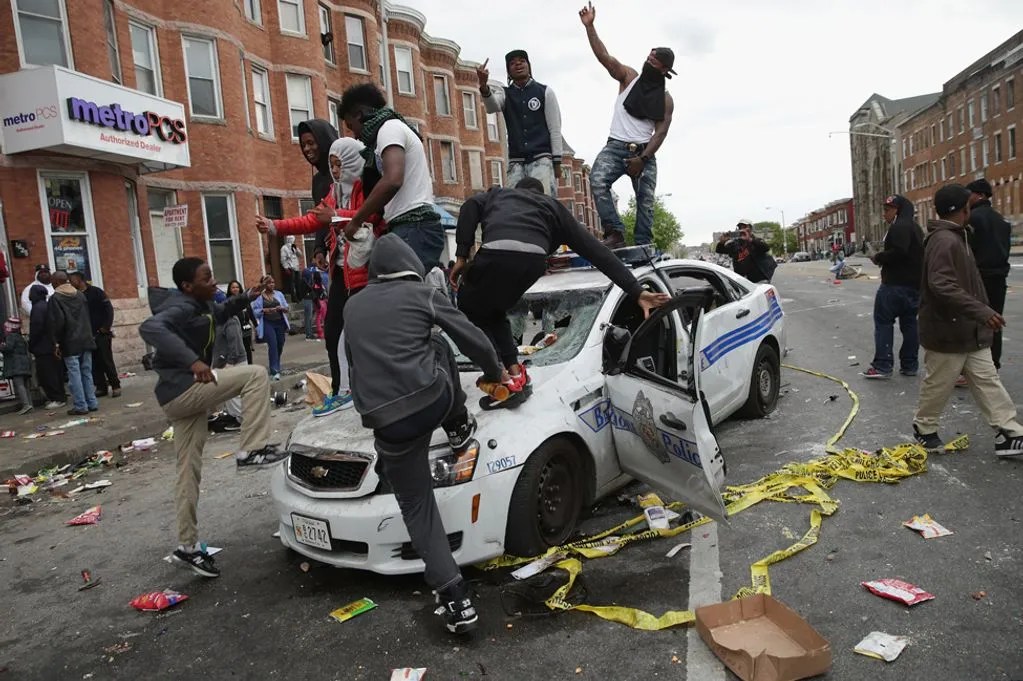
The past few days have seen the eruption of protests and riots in Baltimore after the death of 25 year old Freddie Gray due to what seems to be, at the very least, gross negligence on the part of the Baltimore police. As the media continues to sensationalize these events the public response has been a mix of support and condemnation. Whether one supports the riots/rebellions or not we have to realize that this is nothing new. In this country riots related to racial injustice and police brutality have become a staple every decade or so. Although it is very tempting to label those involved as opportunists (some very well may be), we can’t ignore the fact that there remains a systemic, deeply rooted cause of the riots that are taking place in Baltimore and that have taken place over the last 200 years in this country. In fact, we need to be very careful to look at the history of riots that have taken place around the world throughout history. There is always a reason. We can argue about the legitimacy of the reason, but nevertheless, there is a reason.

Modern theories of crowd behavior have debunked the notion that participants in a crowd are irrational and have no self-control. In fact, when analyzing the way a crowd behaves, two important points are apparent:

1.”Being in a crowd does not entail a loss of identity so much as produce a shift in the focus of self definition among crowd participants away from unique individual attributes to the more shared, group-based defining attributes of the crowd.

2.” Collective action becomes possible when a particular social identity is simultaneously salient and therefore shared among crowd participants.”

In other words, if enough members in a crowd do not share the same sentiments, there will be no collective action and therefore no riot/uprising. We can dismiss the collective feeling of the group as being misinformed and irrational or we can ask what conditions have lead to this collective feeling. In the case of Baltimore,the reasons are too numerous to really unpack here but certainly extend beyond just police brutality and a crucially flawed justice system.

Another thing I want to address is the fact that members of the media as well as people (both black and white) on social media have referred to these individuals as thugs. Now, I would actually be ok with this if the word thug was applied equally to largely white crowds who have rioted for far less important reasons such as those detailed here. However, it is not. In fact, Americans have praised rioters in Egypt, Syria, etc. and have lauded those involved in the riots that served as the prelude to the American Revolution. It is very clear that there is a double standard and that if you’re black you are on the wrong side of it.

Lastly, in reading various social media posts there is a recurring notion that violence does not change anything. This is so far from the truth. I am not saying that I condone violence as a primary or necessary strategy for social change. However, I am saying that it is very clear that violence is extremely effective in changing political, social, and ideological systems. Europeans recognized this very early in there development and employed its use to great effect. The U.S. has also followed in this rich tradition in its use of violence against people of color domestically and globally. Furthermore, protesting and ensuing riots have always been a part of the expression of the populous’s discontent prior to major social change. This trend is seen in the French revolution, the Russian revolution, the Cuban revolution, and yes, even the American revolution. All of these contained riots before the revolution took place in its organized form. What is happening in Baltimore is nothing new. It is the latest in the expression of extreme dissatisfaction from an oppressed population. What will we do about it?

Lessons from “To Pimp A Butterfly”

Finally. It is here. Kendrick Lamar has delivered again, cementing his legacy as arguably our generation’s greatest rapper. I knew that I wanted to write about this album, but once I listened to it I had a hard time deciding what I should actually write about. The album is so dense. There are so many things to talk about, and none of it is trivial. I decided to try to condense the album/my thoughts on the album into three points. Naturally, some things will be missing, but I hope you all can get that conversation going. But, before I talk about some of the main message points, I have to mention the quality of the music/production. The music is so good. In an age where the radio waves are dominated by pre-manufactured, unimaginative music, this is so refreshing. Lamar pays homage to the heritage of black music in America, most notably jazz. This makes sense as the album has heavy doses of production involving Terrace Martin (pretty much on every track), Robert Glasper, Flying Lotus and others. I’ve always found that the mixing of Jazz, soul, funk, and hip hop music is so natural. If you trace the musical lineage, Hip Hop really is the evolution of Jazz. It’s also fitting that an album entitled “To Pimp A Butterfly” is so heavily laced with jazz and other music from the black tradition in a very direct way that goes beyond just using samples. No other art has been pimped in so many different ways than black art. But we’ll get to that.

Now, as I mentioned above, there are so many different levels of metaphors and messages in each song that its really hard to condense it. Beyond that, he also does a genius job of relating and linking multiple concepts to one another. Here’s how I see everything being synthesized:

1. What is success for a black person in America?

The first element of the album that I find most important is the discussion of the internal and external conflicts that come with a high level of success. He deals with this in a number of ways but maybe these are the most critical points:

– There is the conflict of being one of the few that actually makes it out of an environment in which you aren’t supposed to be able to survive and how you balance moving past the elements of your community that hold people back while staying grounded to the elements of your community that give you strength.

-The realization that “making it out” of one struggle only ushers you into a larger conflict that is even harder to fight than the battle you thought you escaped. He realizes that even when you become a rich black person that there are still mechanisms in place to try to control/”pimp” you and that it is easy to lose success, not only in a monetary way, but also in the eyes of the people who you thought were supporting you.

-Lastly, there is the realization that all of the financial gain of success comes with a price and that it doesn’t bring happiness. In the end, he defines success as being able to use his platform to spread a message of enlightenment and help other people break out of the destructive mentality. This point about redefining what success looks like is very critical because the idea that success equals some amount of dollars is the first critical lie that is accepted and necessary for all of the pimping that he talks about throughout the album to occur.

2. When Will We Discuss Mental Health?

Throughout the album, Kendrick talks about his own battles with depression and how they manifest in a number of ways. The song “u” is probably the most poignant in this regard. His inner dialogue reveals many of the self doubts that plague millions of people. And obviously once you have achieved some degree of financial success or fame, the monologue of these self doubts only increases. This depression is in a sense linked to the first point as he discusses how even as people think he is such a success, he knows a number of ways in which he thinks he has failed on an interpersonal level and how that overshadows everything else. He has finally gotten what he was after only to discover that “money can’t stop a suicidal weakness”. Aside from his own personal struggles, the issue of mental health in the black community as a whole is dealt with in a number of nuanced ways throughout the album. To me, this is another super important issue as mental health is one of the most undiscussed but important factors in determining the plight our communities. Here are a few statistics from Mental Health America.

  • Adult blacks are 20 percent more likely to report serious psychological distress than adult whites.
  • Adult blacks are more likely to have feelings of sadness, hopelessness, and worthlessness than are adult whites.
  • While blacks are less likely than whites to die from suicide as teenagers, black teenagers are more likely to attempt suicide than are white teenagers (8.2 percent v. 6.3 percent)
  • African Americans of all ages are more likely to be victims of serious violent crime than are non-Hispanic whites, making them more likely to meet the diagnostic criteria for post-traumatic stress disorder (PTSD).
  • 63 percent of African Americans believe that depression is a personal weakness, this is significantly higher than the overall survey average of 54 percent.
  • In 1998, only 2 percent of psychiatrists, 2 percent of psychologists and 4 percent of social workers self-identified as African Americans.

These are troubling statistics and there are historical and systemic reasons for all of these. One of the results of these disparities is that there are many young black people suffering from undiagnosed depression, anxiety, PTSD, etc. This manifests in a number of ways including anger, violence, and self medication with drugs/alcohol/sex. His openness throughout the album, but especially on the song “u” goes very much against the bravado that has come to characterize much of rap music and hopefully opens up some future avenues for more honest discussion about the mental health issues we all deal with in different ways.

3.”To Pimp a Butterfly” 

To fully understand what this phrase means requires first understanding “To Kill A Mockingbird”. This book covers a lot of ground, but as a starting point here is a quote from the book that probably summarizes the most important point as it relates to the album:

“Mockingbirds don’t do one thing but make music for us to enjoy. They don’t eat up people’s gardens, don’t nest in corncribs, they don’t do one thing but sing their hearts out for us. That’s why it’s a sin to kill a mockingbird.”

The mockingbird in this context is the black person in America who is responsible for the birth of the only original American music and pioneers of pretty much ALL modern popular music. Additionally, the black person has also been subject to extreme unjustified violence (a sin). Now in today’s context, Kendrick re-imagines the black person as more of a butterfly than a mockingbird. This metaphor works on so many levels its ridiculous. Here are two of the more obvious ways he discusses it.

-The butterfly represents the beautiful art, culture, and spirit of the black person and how this is pimped by “the system” for financial gain. He discusses how this happens on both a cultural level as well as on the level of individual artists. Black music has been pimped over and over again, from blues to jazz to rock and now to hip hop. This has always led to a dilution of the spirit and culture that initially was embedded into our art. However, this sort of pimping is not unique to art. In a broad sense there is always a pressure to move away from blackness/revolution/radical change in exchange for more opportunity, financial security, fame, etc. In fact, success within many “professional” circles requires an abandonment of an unapologetically black revolutionary stance or a stance that truly seeks to challenge the system. This is what 2Pac is referring to in the interview at the end of the album:

“In this country a black man only have like 5 years we can exhibit maximum strength, and that’s right now while you a teenager, while you still strong or while you still wanna lift weights, while you still wanna shoot back. Cause once you turn 30 it’s like they take the heart and soul out of a man, out of a black man in this country. And you don’t wanna fight no more. And if you don’t believe me you can look around, you don’t see no loud mouth 30-year old muthafuckas”

As real as this sort of pimping is, Kendrick really focuses more explicitly on the sort of pimping we do to ourselves as a people. I previously wrote about how Kendrick should not be ridiculed for what some people view as respectability politics (check it out). He is representative of every person who has had a first hand view of the issues and sees the internal problem and with the last words of the album he really brings everything full circle, tying together all of the main themes of the album:

“The caterpillar is a prisoner to the streets that conceived it
Its only job is to eat or consume everything around it, in order to protect itself from this mad city
While consuming its environment the caterpillar begins to notice ways to survive
One thing it noticed is how much the world shuns him, but praises the butterfly
The butterfly represents the talent, the thoughtfulness, and the beauty within the caterpillar
But having a harsh outlook on life the caterpillar sees the butterfly as weak and figures out a way to pimp it to his own benefits
Already surrounded by this mad city the caterpillar goes to work on the cocoon which institutionalizes him
He can no longer see past his own thoughts
He’s trapped
When trapped inside these walls certain ideas start to take roots, such as going home, and bringing back new concepts to this mad city
The result?
Wings begin to emerge, breaking the cycle of feeling stagnant
Finally free, the butterfly sheds light on situations that the caterpillar never considered, ending the eternal struggle
Although the butterfly and caterpillar are completely different, they are one and the same.”

Importantly, the butterfly and caterpillar are the same on two levels. Even if you are a black person that has “escaped” to spread your wings and become a butterfly, you can’t escape the larger issue of what it means to be black in America. A black person in corporate America is the same as a black person in Compton because they both have a common struggle that manifests in different ways (completely different, but one in the same). In fact you only truly become a butterfly (or come to represent that which is beautiful about who we are as a people) when you become active in helping those who are still trapped and providing them with the tools to become butterflies as well. Lastly, the butterfly and the caterpillar are the same because they both reside in each person. Each person has talents, gifts, and beauty to offer the community and the world and its up to them to decide whether they will exploit (pimp) themselves in order to achieve some false idea of success and notoriety or whether they will use their gifts for the betterment of the people.

This album is special for many reasons but I think these two quotes really sum up why:

“Hip hop can be a very powerful weapon to help expand young people’s political and social consciousness. But just as with any weapon if you don’t know where to point it, or what you’re using it for you can end up shooting yourself in the foot or killing your sisters or brothers.”- Assata Shakur

“Culture is created only by the people. All artists use this culture. They do not create it…Thus, the artist only represents the People’s culture. The culture of all oppressed is the culture of resistance.The enemy seeks to corrupt the artist into misrepresenting the people’s culture thus betraying them. Thus all artists coming from an oppressed people must represent resistance in their art form. Anything other than this is betrayal.”- Stokely Carmichael

The album has a timely and important message. Many black people of my generation have opportunities that our forefathers could never have dreamed of. How will we use it? The moment we forget what true success is and what the purpose of our talents are, is the moment we not only allow the system to pimp us, but truly, pimp ourselves.

5 times president Obama was right about Christian extremists

At this year’s national prayer breakfast president Obama made a few remarks with regards to ISIS and the seeming threat of Islamic extremism. The quote that garnered the most attention is as follows:

“Lest we get on our high horse and think this is unique to some other place, remember that during the Crusades and the Inquisition, people committed terrible deeds in the name of Christ…In our home country, slavery and Jim Crow all too often was justified in the name of Christ.”

Incredibly, the presidents comments were met with backlash by a number of different individuals. For example, Charles Krauthammer, a conservative columnist, called the presidents remarks “at once banal and offensive”, while Jim Gilmore, former governor of Virginia said that the “The president’s comments this morning are the most offensive I’ve ever heard a president make in my lifetime”.

Ta-Nehisi Coates has already written an excellent article about why backlash to this statement is foolish and historically illiterate. Still, I thought, perhaps there just isn’t any accessible evidence to support such an “offensive” statement. So, as a result, here are 5 times president Obama was right about slavery and Jim Crow being endorsed by Christians. There are way more obviously, but I don’t have the time or energy to list them all.

1. That time Robert Dabney, a famous southern preacher, wrote “while we believe that ‘God made of one blood all nations of men to dwell under the whole heavens’, we know that the African has become, according to a well-known law of natural history, by the manifold influences of the ages, a different, fixed species of the race, separated from the white man by traits bodily, mental and moral, almost as rigid and permanent as those of genus.” (from his book A Defense of Virginia and the South)

from Types of Mankind(1854)

2. That time James Henry Thornwell said “Slavery again reappears under the Law. God sanctions it in the first table of the Decalogue, and Moses treats it as an institution to be regulated, not abolished; legitimated and not condemned. We come down to the age of the New Testament, and we find it again in the churches founded by the apostles under the plenary inspiration of the Holy Ghost. These facts are utterly amazing, if slavery is the enormous sin which its enemies represent it to be. It will not do to say that the Scriptures have treated it only in a general, incidental way, without any clear implication as to its moral character. Moses surely made it the subject of express and positive legislation, and the apostles are equally explicit in inculcating the duties which spring from both sides of the relation. They treat slaves as bound to obey and inculcate obedience as an office of religion a thing wholly self-contradictory if the authority exercised over them were unlawful and iniquitous.” (from a speech to the General Assembly of the Presbyterian Church in the Confederate States of America,, 1861)

3. That time Jefferson Davis said “[Slavery] was established by decree of Almighty God…it is sanctioned in the Bible, in both Testaments, from Genesis to Revelation…it has existed in all ages, has been found among the people of the highest civilization, and in nations of the highest proficiency in the arts.” (from his Inaugural Address as Provisional President of the Confederacy)

4.  That time Dr. Wesley A. Swift, “a dynamic, inspired speaker who taught uncompromised Biblical truths” founded a movement in the 1940s that is now represented by various ministries today. This is from the doctrinal statement of beliefs from one of those ministries, Kingdom Identity Ministries:

WE BELIEVE that as a chosen race, elected by God (Deut. 7:6, 10:15; I Peter 2:9), we are not to be partakers of the wickedness of this world system (I John 2:15; James 4:4; John 17/9, 15, 16), but are called to come out and be a separated people (II Cor. 6:17; Rev. 18:4; Jer. 51:6; Exodus 33:16; Lev. 20:24). This includes segregation from all non-white races, who are prohibited in God’s natural divine order from ruling over Israel (Deut. 17:15, 28:13, 32:8; Joel 2:17; Isa. 13:14; Gen. 1:25-26; Rom. 9:21). Race-mixing is an abomination in the sight of Almighty God, a satanic attempt meant to destroy the chosen seedline, and is strictly forbidden by His commandments (Exo. 34:14-16; Num. 25:1-13; I Cor. 10:8/ Rev. 2:14; Deut. 7:3-4; Joshua 23:12-13; I Kings 11:1-3; Ezra 9:2, 10-12; 10:10-14; Neh. 10:28-30, 13;3, 27; Hosea 5;7; Mal. 2:11-12).”

5. Or how about that time the Ku Klux Klan was a self-proclaimed christian organization. Guess what sorts of activities they are most notable for spearheading:

and

and

So, you’ll have to forgive those of us who found the honesty in the president’s remarks refreshing. It is a serious symptom of American politics that his comments were attacked the way they were. It points to our inability as a nation to deal honestly with historical facts, learn from them, and move forward. Just because something doesn’t make you feel good, it doesn’t mean it isn’t true, doesn’t mean it didn’t happen, and doesn’t mean that it will go away. That applies equally to Muslims and Christians, just like all other truths.

The politics of black hair

Some years ago, I had the opportunity to attend a national research conference as an undergraduate research fellow. While there, I found myself having a conversation with a group of scientists in which one gentleman remarked something to the effect of “Your hair is interesting, it must be pretty dirty.” I had early stage dreadlocks and this wasn’t the first time I had heard such a remark in this sort of setting. I took it as an opportunity to educate and kept it moving. When it was time to apply to medical school, I was told that I should cut my hair in lieu of a more “professional” look. I didn’t cut my hair. My rationale was that if my hair was the thing to keep me out of a given medical school, such an overtly racist institution wouldn’t be a place I was comfortable at anyway. After getting into medical school, a common question was “Are you going to cut your hair before entering the clinic in third year?” There was a thought that patients might be uncomfortable or think of me as being unprofessional. Recently, a graduate school friend of mine, who had a decent sized afro, was interviewing for positions at leading consulting firms. He was told from an insider that he needed to cut his hair if he was to have a chance of getting a job. Even more recently, a high school classmate of mine wrote me regarding his experiences with dreadlocks and how in his country of origin he was treated differently because of his hair. These things got me thinking about why certain black hairstyles are deemed unprofessional and how this was a part of a larger issue regarding the setting of and adherence to normative standards.

In America, the classic standards of professionalism, beauty, intelligence, etc. were set in conjunction with an undercurrent of white supremacy. As a result, these standards exalt the white ideal while deeming everything else inferior or subpar. So It is not a coincidence that the “ideal” professional hairstyles for black men are those that keep the hair as closely cut to the scalp as possible, hiding the most salient qualities of black hair. Just as it is not a coincidence for black women that straightened hair is viewed as the “ideal” way to wear one’s hair in a professional setting.

Outside of just professional circles, hair has been tied to a larger psychological battle regarding standards of beauty. It is really interested to think about what makes something or someone beautiful and whether or not these things are defined by innate guidelines or by culture. There is a significant amount of research showing that certain qualities such as facial symmetry seem to be innately preferable regardless of culture. From an evolutionary standpoint, it is thought that picking a mate with more facial symmetry is preferable as this person is likely to have less genetic aberrations and be healthier. Conversely, many genetic disorders tend to also alter facial symmetry to some degree. So arguably this is one example of an innate feature of beauty. However, it is also clear that many other traits are only viewed as attractive or acceptable based on the culture one is in.

aprilfoolromance.blogspot.com

In American culture, the standard has always been decided based on a white ideal. From the first time Africans were brought to this country as slaves, there has been a societal pressure to conform to a white standard of beauty. The coupling of this with a loss of African tradition and culture lead to an eventual adoption of that standard of beauty as our own. Multiple psychological experiments have shown that this bias towards a white standard is evident, even in young children. The most famous of these is the doll experiments of Kenneth and Mammie Clark. These experiments have been repeated much more recently and have yielded similar results. In addition, similar experiments have been done showing a preference for straight hair over “nappy” hair.

Now, because our hair has always either explicitly or implicitly been viewed as inferior in terms of standards of beauty and because this was a part of a larger systemic program for projecting the supposed inferiority of black people, for black people, hair became political. This fact can be seen most evidently in the black power movement of the 60s and 70s.

Here, a rejection of white supremacy and an embracing of blackness lead to natural hair as the style of choice. One’s hair became a statement of his or her rejection of society’s standard. A similar phenomenon was also seen in Rastafarian culture where the hair served as a symbol of the rejection of what was the societal norm/preference.

Today, the pressures to conform to a standard of beauty that we do not define are much less overt. However, they are still there. They are there in the seemingly innocuous yet ignorant comments. They are there when you look at the google image results for the word “beauty”. They are there when the top 15 contestants of the Miss Universe pageant look like this:

napturalnicole.com

They are also there when you cannot get a job that you are qualified for because your hair is either in its natural state or styled in a way that does not hide its African qualities.

Of course, there are practical reasons why one might choose to straighten their hair or cut their hair short and that is not to be denied. It is certainly possible to have straight and/or short hair and define one’s own standards of beauty and be a conscious black person. It is equally possible to have natural hair, dreadlocks, etc. and be completely unconscious. As Jamil Abdullah Al-Amin (formerly known as H. Rap Brown) said “I’d rather see a cat with a processed head and a natural mind than a natural head and a processed mind”. However, one must understand the history of what it means to wear black hair in a certain way and understand that in certain contexts and for certain people, your hair is a political statement, as much as a fashion one. Whether you like it or not.

Kendrick Lamar, Malcolm X, and the truth in respectability politics

Kendrick Lamar has recently received social media criticism as a result of some comments that he made in a Billboard article. When asked about the Michael Brown shooting, this is what he said:

“I wish somebody would look in our neighborhood knowing that it’s already a situation, mentally, where it’s f—ked up. What happened to [Michael Brown] should’ve never happened. Never. But when we don’t have respect for ourselves, how do we expect them to respect us? It starts from within. Don’t start with just a rally, don’t start from looting — it starts from within.”

Now a lot of people are upset with Kendrick for this statement. Many feel that it reeks of “respectability politics”. You can read some good articles on respectability politics here and here, but essentially, respectability says that there is something wrong in the black community and that we must right this wrong before we will be recognized, accepted and respected by the majority society aka white people. A lot of people don’t like respectability politics because they see it as victim blaming while ignoring the institutional forces that create and reinforce the conditions seen in the victim. Although this is a valid critique, I think there is some truth in the sentiments behind respectability. However, I believe that this truth is misguided in its ultimate goals. Let me explain.

The first premise of respectability politics is that there is something wrong in the black community.  This is what Kendrick is referring to when he says “I wish somebody would look in our neighborhood knowing that it’s already a situation, mentally, where it’s f—ked up.” As a young black male from Compton, he certainly has seen some of the worst things that occur in black communities. Indeed, his classic album Good Kid, m.A.A.d. City refers to many of those things.

(As an aside, with Good Kid m.A.A.d. City, Kendrick arguably stated the situation of today’s inner city black youth more accurately and profoundly than any other recent artist over the past 10 years. So, I think he gets a little leeway to state his opinion without lesser artists jumping down his throat with alot of rhetoric and little real substance.)

However, we don’t even have to take his word for it. There is enough evidence in the statistics across education, crime, health, etc. to show that there is something wrong. I don’t think is debatable. Now, I also don’t think its debatable that the majority of these problems were not created by black people, but rather is the result of a long white supremacy legacy that includes everything from slavery to the prison industrial complex. These things have lead to psychological, economical, social, cultural, and all other sorts of problems that affect us today. However, regardless of who is responsible for creating the problems, the reality of today is that they exist.

Now, the second premise of respectability says that black people need to fix their problems and behave in a certain way in order to be accepted and respected by the majority culture. Kendrick refers to this  when he says

“But when we don’t have respect for ourselves, how do we expect them to respect us? It starts from within. Don’t start with just a rally, don’t start from looting — it starts from within.”

Now again, he puts the onus on the community to fix itself before it seeks to be granted recognition from the majority culture. This makes sense. Most of the protests and rallies that I see are done with the goal of being respected as equals within the existing system. If this is your goal, respectability is logical because the chances of you being accepted or respected by the majority culture when you don’t adhere to its standards are absolutely zero. This stance in no way negates the importance of the effects of institutional racism, it just says that it won’t change until you adhere to the standards of the majority. This is a dubious proposal that I don’t necessarily believe in, but it is not a nonsensical one. As I mentioned in a previous post, you  can change every policy and law you want, but that won’t change the way people think. If the people you are trying to bargain with for equality have a certain standard, you have to adhere to that standard in order for them to take you seriously. Since, it seems that many of today’s social justice movements want to work within the current system to bring about change, then ultimately, respectability will have to be a part of their drive if those movements will be successful.

Where I diverge from respectability in its classic sense is that I think the goal of gaining the respect of the majority culture is the wrong goal to have because this sort of philosophy relies on the majority culture to ultimately bring about change after black people have shown themselves worthy. However, we can use respectability in a different way. We can first admit there is an internal problem. Then we can say to hell with waiting and appealing for acknowledgment of our equal humanity and instead, work to solve our problems ourselves. In an interview with Dr. Kenneth Clark, Malcolm X said:

“…when Negroes stop getting drunk, when Negroes stop fornicating and committing adultery, when Negroes stop being addicted to drugs, and these things that destroy the moral fiber and the morale of the Negro, then our people will be able to get together and unite in harmony and unity, and get our own problems solved”

This is my type of respectability politics. I’m not saying we need to be pious members of the Nation of Islam, but the general sentiment rings true. This respectability is NOT aimed at approval from the majority culture, it is aimed at internal approval, improvement, acceptance, and unity in order to facilitate organization and ultimately, real change. This is what I think Kendrick is saying when he says It starts from within and not from a rally or from looting. Rallies and looting are reactive and aimed at the oppressive system. “Starting from within” is proactive and aimed at ourselves.

I love the way Chris Rock captures the situation in this interview with the Breakfast club (go to 21:10 for comment)

He used this analogy. If you are driving down the street and you damage your car by running into a pothole you should write to the city government to alert them about the hole and implore them to come and fix it. Now, if after months of writing the city, they have not come, you have a decision to make. Despite the fact that it is wrong that the hole is there and it is wrong that they won’t fix it, the reality is that you have to deal with the hole. Avoid the hole, fix the hole, build a new road, but don’t continue to damage your car in the hole because of the inability of the city to do the right thing.

Two questions for today’s activist

50 years ago, the civil rights act of 1964 was passed. This law was supposed to end discrimination against human beings based on race, color, religion, sex, or national origin. This act, essentially, further legislated the tenets that were supposed to have been ensured to black people by the 14th amendment. The Voting Rights Act of 1965, and the 1968 Fair Housing Act promptly followed the 1964 law. These three pieces of legislation were the crowning jewel of the 1960s Civil Rights movement and were supposed to provide equality to black people in this country. Yet, here we are 50 years later, trying to put forth the 400-year-old argument that “Black Lives Matter”. In the wake of increased mass attention to an always existing issue, we are yet again appealing to the government to offer us freedom, equality, and justice under the law with the notion that we too, are human beings, and as a result should be viewed and treated equally to other human beings with which we share this country.

Now, as absurd as it is to me, that in 2015, we must still seek to put forth and convince some part of the population of the fundamental truth that “all men are created equal” and all that logically extends from that, this is the situation we find ourselves in. So, it seems to me that the current movement is philosophically aligned with the 1960s civil rights movement in one way: It says that we must ask, appeal, or coerce those in power to change the current system in order to make our society truly free and equitable. If this is the case, I think it is critical for the modern day activist, black or white, to ask two questions:

1. Can true freedom be given?

2. Is this system capable of providing the type of change that is necessary?

Neither of these questions are novel and have been historically asked and answered by various revolutionaries, activists, and movements. However, the answers to these questions seems to me to be critically important in determining how we use mass action to achieve our goals. I don’t claim to have the answer to these questions, but here are some very brief thoughts.

Can true freedom be given?

Most current philosophies maintain that we are born free and equal. To be in a position where you have to ask for your freedom indicates that at some point it was taken. When one is convinced that his or her own freedom has been taken, there is a decision about how one goes about reclaiming that freedom. To ask for, and then be given back your rightful freedom does little to nothing to correct the power dynamic that was established when it was initially taken. Some might conclude that this sort of concession isn’t true freedom as there is an inherent psychological inequality in the process. On the other hand, while actively taking freedom equilibrates the power dynamic, it is much more costly, especially if those that have it won’t willingly give it back.

Is this system capable of providing the type of change that is necessary?

It is unclear whether this system is capable of actually providing us with the type of intrinsic equality, freedom, and value that we want. We have, over the course of over one hundred years, seen many laws passed that were supposed to provide change. These laws have indeed helped to mitigate the current of white supremacy that the country was built on. However, they have not destroyed the tenets of white supremacy that underlie many of the issues we are still fighting for. One cannot legislate paradigm shifts and changes in philosophy. In fact, these processes tend to lead to changes in the very systems that have power to legislate. So we have to ask ourselves whether this country, under its current system, is positioned to make the types of meaningful changes that will make it unnecessary to have to legislate the equality of all human beings living here.

Consider the following statement:

“Whenever any form of government becomes destructive of [the rights of the people being governed] , it is the right of the people to alter or to abolish it, and to institute new government, laying its foundation on such principles and organizing its powers in such form, as to them shall seem most likely to effect their Safety and Happiness [. . .]Prudence, indeed, will dictate that governments long established should not be changed for light and transient causes [. . .] But when a long train of abuses and usurpations, pursuing invariably the same object evinces a design to reduce them under absolute despotism, it is their right, it is their duty, to throw off such government, and to provide new guards for their future security.”

This is taken from America’s Declaration of Independence. Americans, in effect, answered “NO” to the question “Is this system capable of providing the type of change that is necessary?” and sought to create a new government that they felt would secure their “safety and happiness” as well as “future security”. Today’s American (black and white) must seek to answer this question again as we are currently faced with a “long train of abuses and usurpations”. A train that has been traveling for hundreds of years; much longer than the 13 colonies “suffered” under Great Britain.

follow on instagram @drtr3